Employment Disability Discrimination New York: Your Rights
Reviewed for accuracy by the ADAhelp team before publishing. ADAhelp is not a law firm; legal work is handled by independent New York attorneys.

Facing employment disability discrimination in New York? Learn how NY's three-law stack protects you. Find out if you have a case and can recover lost wages.
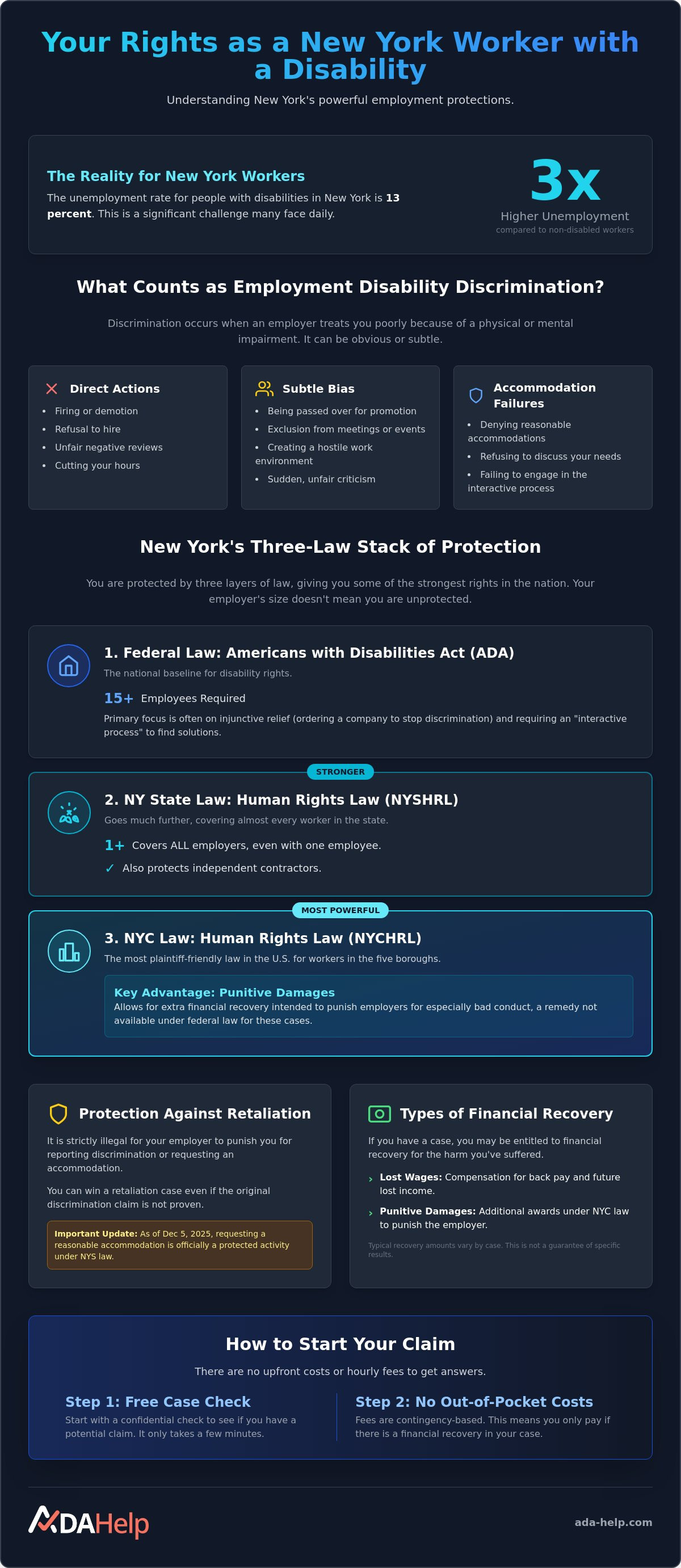
Did you know that the unemployment rate for people with disabilities in the New York labor market is 13 percent, which is three times higher than for non-disabled workers? If you were pushed out of your job or denied a reasonable accommodation, you are likely facing the reality of employment disability discrimination New York workers deal with every day. It is normal to feel overwhelmed by the fear of retaliation or confused by the complex web of local regulations.
You are right to feel that what happened was unfair, and you don't have to handle the burden alone. New York laws provide a powerful three-law stack of protections through the federal Americans with Disabilities Act (ADA); the New York State Human Rights Law (NYSHRL); and the New York City Human Rights Law (NYCHRL). These rules ensure that even small businesses and independent contractors are held to high standards of fairness.
This article explains your rights to financial recovery for lost wages and potential punitive damages. You will learn how to identify if you have a case and how to start a claim with a free case check. There are no upfront costs or hourly fees; you only pay if there is a recovery in your case.
Key Takeaways
- Discover how the three-law stack of federal, state, and city regulations provides the strongest workplace protections in the country.
- Learn what qualifies as employment disability discrimination New York law prohibits, including firing, demotion, and the denial of reasonable accommodations.
- Understand why New York State and City laws protect you even if you work for a small company or are an independent contractor.
- Identify the types of financial recovery available, such as lost wages and punitive damages under the New York City Human Rights Law.
- Find out how to start your claim with a free three-minute case check and no out-of-pocket costs.

What Counts as Employment Disability Discrimination in New York?
Did your supervisor start acting differently after you mentioned your back injury? Employment disability discrimination New York workers face often starts with subtle shifts in attitude before turning into lost wages or a lost job. At its core, discrimination happens when an employer treats you poorly because of a physical or mental impairment. This includes blatant actions like firing or demoting you, but it also covers refusing to hire you because they assume you can't do the work. Harassment that creates a hostile work environment is another common form of bias that makes it impossible to succeed.
New York provides some of the strongest protections in the nation. Under the New York State Human Rights Law, you are protected whether your disability is permanent, temporary, or simply perceived by others. Even if you don't consider yourself disabled, if your boss thinks you are and treats you worse because of it, you may have a claim. While the federal ADA only covers companies with 15 or more employees, New York State law covers every employer, regardless of size, including independent contractors. This ensures that almost every Real New Yorker has a path to justice.
Common Examples of Workplace Bias
Discrimination isn't always a pink slip. It often shows up in small ways that hold your career back. You might be passed over for a promotion despite having the best qualifications because your manager worries about your future medical appointments. Perhaps you received glowing reviews for years, only to face sudden, unfair criticism after disclosing a medical condition. Other times, bias looks like exclusion. If your team holds mandatory meetings in a room you can't access, or if you are left out of company events because of your disability, your rights are likely being violated. These actions create a barrier between you and the income you deserve.
Protection Against Retaliation
Are you afraid that speaking up will make things worse? It is strictly illegal for an employer to punish you for reporting discrimination or requesting a change to help you work. This is called retaliation. It often takes the form of cutting your hours, changing your job duties to something less desirable, or writing you up for things they used to ignore. Effective December 5, 2025, requesting a reasonable accommodation is officially a protected activity under state law. New York laws provide separate penalties for employers who retaliate. This means even if a court finds the original discrimination didn't happen, you can still win your case if the employer punished you for complaining about it.
The Three Laws Protecting New York Workers With Disabilities
New York workers are unique because they sit under three layers of legal protection. Most people only know about the federal law. However, state and city rules often provide much stronger paths to financial recovery. If you are experiencing employment disability discrimination New York laws ensure that your employer is held accountable. It doesn't matter how large or small the company is. These three laws work together to cover almost every workplace scenario.
The Americans with Disabilities Act (ADA)
The Americans with Disabilities Act is the federal baseline for disability rights. It applies to employers with 15 or more employees. While it is a famous tool, its primary focus is often on injunctive relief. This means the court orders a company to stop discriminatory practices or change their policies. Under the ADA, your employer must engage in an interactive process. They are required to talk to you to find a solution that helps you do your job. If they refuse to even discuss your needs, they may be violating federal law.
New York State and City Human Rights Laws
The New York State Human Rights Law (NYSHRL) goes much further than the federal ADA. It covers businesses with even one employee. It also specifically includes independent contractors. This is vital for workers in smaller offices or gig economy roles. These individuals are often left out of federal protections. New York State ensures they have a voice too. As of December 2025, the NYSHRL also explicitly prohibits retaliation against you for simply asking for a reasonable accommodation.
If you work within the five boroughs, the New York City Human Rights Law (NYCHRL), enforced by the NYC Commission on Human Rights, is your most powerful asset. It is the most plaintiff-friendly law in the United States. Unlike federal law, the NYCHRL allows for the recovery of punitive damages. These are extra payments meant to punish an employer for particularly bad behavior. Both state and city laws also allow for compensatory damages. These cover emotional distress and the money you lost because of the discrimination. This three-law stack ensures you have multiple paths to recovery.
Understanding which law applies to your specific situation is the first step toward justice. You can check your eligibility online to see which protections apply to your workplace. This simple step helps you move from confusion to a clear plan for action.
Reasonable Accommodations: Your Rights and Employer Obligations
Does your current desk setup cause you physical pain? Or perhaps you need a slightly different schedule to manage your medical treatments? A reasonable accommodation is any change to your work environment or the way your job is usually done that allows you to perform your essential duties. If you have a disability, your employer has a legal duty to help you stay productive. When a company refuses to make these small changes, it often turns into a case of employment disability discrimination New York workers can fight to resolve.
The process of finding a solution is not a one-way street. In New York, your boss must engage in an "interactive process." This is a mandatory, good-faith dialogue where you and your employer discuss your needs and explore possible solutions. You don't need to use legal terms to start this. Simply telling your supervisor that you need a change because of a medical condition is enough to trigger their responsibility. If an employer ignores your request or shuts down the conversation without a valid reason, they are violating the law. Under the NYCHRL and NYSHRL, the failure to engage in this process is a stand-alone violation, even if an accommodation was eventually possible.
What Qualifies as a Reasonable Accommodation?
Accommodations are usually simple and low-cost. Many employers assume they have to spend thousands of dollars, but that is rarely the case. Common examples that help Real New Yorkers stay in the workforce include:
- Modified work schedules: Adjusting your start or end times so you can attend weekly medical appointments or therapy sessions.
- Specialized equipment: Providing a standing desk, screen-reading software, or a chair that supports your specific physical needs.
- Task reassignment: Moving non-essential parts of your job to another staff member if those tasks interfere with your disability.
- Remote work: Allowing you to work from home if commuting or being in the office is a barrier to your health.
When Can an Employer Say No?
An employer can only legally deny your request if they can prove it creates an "undue hardship." This means the accommodation would be significantly difficult or expensive for the business to implement. However, they cannot just say it's too much trouble. New York courts set a very high bar for what counts as a hardship. They look at the size of the company, its overall budget, and the nature of its operations. A large corporation in Manhattan will have a much harder time claiming a desk adjustment is too expensive than a tiny mom-and-pop shop would. Even if your first choice is too difficult, the employer must work with you to find the next best alternative that keeps you on the job.
Proving Your Case: Documentation and Deadlines
Evidence is the bridge between a gut feeling and a successful claim for financial recovery. If you are facing employment disability discrimination New York laws require more than just your word to hold an employer accountable. You need a clear paper trail that tells a story of unfair treatment. Without documentation, it often becomes your word against theirs. Building a strong case starts the moment you suspect something is wrong.
You don't need to be a legal expert to gather what you need. Most successful claims are built on the small, everyday interactions that prove a pattern of bias. Whether it's a series of ignored emails or a sudden change in how your manager speaks to you, every detail matters. This documentation is what allows case managers to see the reality of your situation and help you move toward a resolution.
How to Document Workplace Discrimination
Don't rely on your memory alone. Details fade quickly under the stress of a hostile work environment. Start a private log immediately. Write down the date, time, and specific location of every incident. Include the names of any coworkers who witnessed the event. If a manager makes a comment about your disability, write down exactly what they said. You should also keep copies of all relevant records, such as:
- Email chains: Save messages where you requested an accommodation or where your boss criticized your performance after learning of your medical condition.
- Performance reviews: Keep copies of positive reviews from before you disclosed your disability to show the sudden change in how you were treated.
- Medical records: Maintain a file of doctor's notes and accommodation requests you submitted to HR.
Always store these records in a safe place outside of your work computer or office. If you are fired or locked out of your company email, you will lose access to your evidence. Save everything to a personal cloud drive or print physical copies to keep at home. Having this information ready makes the process faster and less stressful when you are ready to take action.
Understanding New York Filing Deadlines
Time is your enemy in any discrimination claim. Every law in the "three-law stack" has its own expiration date, known as a statute of limitations. For federal claims under the ADA, you generally must file a charge with the Equal Employment Opportunity Commission (EEOC) within 300 days of the incident. This is a very tight window that closes faster than most people realize. If you miss it, you may lose your right to pursue federal relief.
Fortunately, New York State and City laws are more generous. You usually have three years from the date of the discriminatory act to file a claim under the NYSHRL or the NYCHRL. However, waiting is never a good strategy. Witnesses move away and documents get lost. Missing these deadlines can permanently end your right to seek recovery for lost wages or emotional distress. You can start a free case check today to ensure your claim is filed on time and your rights are protected.
Where to File: Agencies & Deadlines
Depending on which law fits your situation, an employment disability discrimination claim in New York is filed with one of these agencies. Each has its own deadline, so confirm yours early:
- NY State Division of Human Rights (DHR) — enforces the NYSHRL statewide. File within 3 years of the discriminatory act.
- NYC Commission on Human Rights (CCHR) — enforces the NYCHRL in the five boroughs. File within 3 years.
- Equal Employment Opportunity Commission (EEOC) — handles federal ADA charges. File within 300 days of the incident.
- U.S. Department of Justice (DOJ) — enforces broader ADA rights and accepts ADA complaints.
You do not have to choose the right agency on your own. Our case managers evaluate all three laws and file with the correct authority for you — see how our New York discrimination resolution process works from start to finish.
How to Start Your Disability Discrimination Claim Today
Have you lost your job because of a medical condition? The financial stress of losing your income is enough to deal with on its own. You shouldn't have to worry about how to pay for help too. Many people hesitate to seek justice because they assume the process is too expensive or too complicated. At ADAhelp, we remove those barriers for Real New Yorkers. We provide a clear path to resolution for employment disability discrimination New York workers experience every day.
We work on a contingency basis. This means there are no out-of-pocket costs for you. If we don't secure a recovery for your case, you don't owe us a fee. This low-risk approach puts the burden on us, not you. Here is how the no-upfront-cost contingency model works in practice. You can focus on your recovery and your future while we handle the complex paperwork and deadlines mentioned earlier. We take care of the heavy lifting so you can get your life back on track without financial fear.
The ADAhelp Case Management Process
Our team makes the process as simple as possible. First, we gather the evidence you've collected, such as the logs and emails we discussed in the previous section. We evaluate the strength of your claim using the three-law stack of the ADA, NYSHRL, and NYCHRL. Once we have the facts, we handle the filing with the correct state or federal authorities. You won't have to guess which agency to contact or which forms to fill out — see what to expect when you get help with your discrimination claim. We provide updates in plain English; you will always know where your case stands without needing to decode complex legal jargon.
Why Real New Yorkers Choose Us
We aren't a general service. We focus exclusively on disability discrimination within New York State and City. This regional focus means we understand the specific nuances of the NYCHRL, which is the most plaintiff-friendly law in the country. Our goal is to make the process fast and stress-free. You've already been through enough. Let us take the weight off your shoulders. Check your eligibility now with our free three-minute case check. It takes just three minutes to find out if you have a claim. Start your path to recovery today with a simple, free case check.
Take the First Step Toward Your Recovery
You now understand how the three-law stack of the ADA, NYSHRL, and NYCHRL protects your career and your income. Whether you were denied a simple desk adjustment or faced a sudden termination, the law is on your side. Proving employment disability discrimination New York cases depends on the evidence you collect and meeting the strict deadlines set by the state. You don't have to be an expert to hold an unfair employer accountable.
ADAhelp handles the case management so you can focus on moving forward. We specialize exclusively in New York State and City laws to ensure your rights are fully protected. Our process is entirely contingency-based, meaning there is no recovery and no fee. This ensures you face zero financial risk while we handle the heavy lifting for you.
You've been through enough stress already. Let us help you find the justice and financial recovery you deserve. Start your free three-minute case check now to see if you have a claim.
Frequently Asked Questions
Is depression considered a disability under New York law?
Yes, depression is a protected disability. New York laws use a very broad definition for disabilities that includes physical, mental, and medical impairments. You are protected if you have a record of such a condition or if your employer simply perceives you as having one. Unlike some federal standards, you don't need to prove your condition is permanent to be covered under state or city rules.
Can I be fired for a disability in New York?
No, it is illegal for an employer to fire you because of a physical or mental impairment. If you can perform the essential duties of your job with or without a reasonable accommodation, your position is protected. If you were terminated shortly after disclosing a medical condition or requesting a change to your workspace, you may be a victim of employment disability discrimination New York laws strictly prohibit.
How many employees must a company have for the ADA to apply?
The federal Americans with Disabilities Act applies to companies with 15 or more employees. However, Real New Yorkers are protected regardless of their company's size. The New York State Human Rights Law covers all employers in the state, even those with only one worker. You have rights even if you work for a tiny start-up or a small family business.
What is the interactive process for reasonable accommodations?
The interactive process is a mandatory, good-faith dialogue between you and your employer. Once you let your boss know you need a change to help you work, they must talk to you to find a solution. They cannot simply ignore your request or say no without exploring other options first. Failing to engage in this conversation is a specific violation of both city and state laws.
Can I sue for disability discrimination if I am an independent contractor?
Yes, you can. While federal laws often leave out freelancers and contractors, the New York State Human Rights Law was updated to include them. If you are an independent contractor facing bias or a hostile work environment in New York, you have the same right to seek a recovery as any other employee. Your status as a non-staff worker does not take away your right to fairness.
What is the difference between the ADA and the New York City Human Rights Law?
The ADA is a federal law that provides a baseline of protection across the country. The New York City Human Rights Law is much more powerful and is often called the most plaintiff-friendly law in the nation. It covers more workers and allows for punitive damages, which are payments meant to punish an employer for bad behavior. It is the strongest tool available for workers in the five boroughs.
How much does it cost to file a disability discrimination claim?
It costs you nothing out of pocket to start your claim with ADAhelp. We operate on a contingency basis, which means we only get paid if we successfully recover money for you. If there is no recovery, there is no fee. Our initial case check is also free and takes only three minutes to complete online.
What kind of damages can I recover in a New York disability case?
You can seek several types of financial recovery depending on your specific situation. This typical list includes back pay for lost wages and "front pay" if you can't return to your old job. You can also receive compensatory damages for emotional distress and pain. Under the New York City Human Rights Law, you may even be eligible for punitive damages if your employer acted with reckless indifference to your rights.

Article by
ADA Help
Written by the ADAhelp editorial team and reviewed for accuracy before publishing. ADAhelp helps New Yorkers find out if they have a disability discrimination claim and manages the process end to end, working with independent attorneys who handle the legal work. We are not a law firm and do not provide legal advice.
Disclaimer
This article is general information about New York law, not legal advice, and reading it does not create an attorney-client relationship. ADAhelp is a case-management and intake service, not a law firm; legal representation is provided by independent attorneys. Recovery amounts and timelines vary by case, and past outcomes do not guarantee future results. For advice about your specific situation, speak with a qualified attorney or start the free case check.
Tags
Discriminated against in New York because of a disability?
A free three-minute check tells you if you can pursue a claim.
Check my case →New York onlyNo upfront costIndependent NY attorneysFree 3-minute check