Public Access Discrimination New York: Know Your Rights
Reviewed for accuracy by the ADAhelp team before publishing. ADAhelp is not a law firm; legal work is handled by independent New York attorneys.
Public access discrimination in New York: when a business denies disability access. NY laws can recover damages the federal ADA can’t — check your claim free.
Public access discrimination in New York means being denied equal access to a business or public place because of a disability — a store with no ramp, a restaurant that turns away your service animal, a website you can’t use with a screen reader. Your rights here go further than most people realize: alongside the federal ADA, New York’s State and City human-rights laws can provide money damages the ADA usually can’t. This guide to public access discrimination New York residents can rely on covers what counts as a violation, the barriers that come up most often, how the federal, state, and city laws differ, how to document and file a complaint, the remedies and enforcement available, and how to check in about three minutes whether you have a claim — at no cost.
What is Public Access Discrimination in New York?
Being denied entry to a store, unable to navigate a restaurant, or refused service because of a disability is not just an inconvenience; it is illegal. Public access discrimination occurs when a business or entity open to the public fails to provide equal access to individuals with disabilities. This is a direct violation of your civil rights under federal, state, and city laws.
In New York, these protections are defined by the Americans with Disabilities Act (ADA), the New York State Human Rights Law (NYSHRL), and the New York City Human Rights Law (NYCHRL). A key concept is the “place of public accommodation,” which is any business or non-private facility that offers goods or services to the public. The law does not care if a barrier is intentional or an oversight. A step at the entrance or a policy that excludes service animals creates an illegal barrier, regardless of the business owner’s intent.
Crucially, New York’s laws often provide stronger protections than the federal ADA. They cover more businesses and offer more significant remedies for victims of discrimination. This means if you have faced public access discrimination New York gives you a powerful legal framework supporting your right to access. If your situation involves a managed claim rather than a quick fix, our overview of ADA case assistance in New York explains how the process works end to end.
Who is Protected Under New York Law?
New York’s anti-discrimination laws are intentionally broad to protect as many people as possible. If you have a physical, medical, mental, or psychological impairment, you are likely protected. This includes, but is not limited to, individuals with:
Physical disabilities and mobility impairments: This includes individuals who use wheelchairs, walkers, canes, or have other conditions that affect their mobility.
Sensory disabilities: Protections cover individuals with visual impairments (blindness or low vision) and hearing impairments (deafness or hard of hearing).
Service animal users: New York law grants specific, robust access rights to individuals who use trained service animals. A business cannot deny you entry because you are accompanied by your service animal.
Common "Public Accommodations" Examples
The term “public accommodation” covers nearly every type of business you interact with daily. It is not limited to large corporations; even the smallest local shops must comply. Examples include:
Restaurants, bars, and coffee shops
Retail stores, from small boutiques to large shopping malls
Hospitals, doctors' offices, clinics, and other professional offices
Private schools, daycare centers, and other educational institutions
Gyms, movie theaters, and concert halls
Hotels and other lodging establishments
If a business is open to the general public, it must be accessible to people with disabilities.
Common ADA Violations in New York Businesses
Public access discrimination takes many forms. While some violations are obvious, like a flight of stairs with no ramp, others are less visible but equally illegal. Understanding these common barriers can help you identify when your rights have been violated.
Physical barriers: These are the most common violations. They include entrances with steps but no ramps, doorways that are too narrow for a wheelchair, inaccessible restrooms without grab bars or adequate space, and service counters that are too high.
Communication barriers: A business fails to provide accessible communication when it lacks Braille signage for permanent rooms, fails to provide qualified American Sign Language (ASL) interpreters when needed for effective communication, or does not offer auxiliary aids for people with vision or hearing impairments.
Policy barriers: These are rules or practices that discriminate against people with disabilities. Common examples include refusing to allow a service animal entry, creating "no-exceptions" seating policies that prevent accessible seating, or illegally questioning a person about their disability.
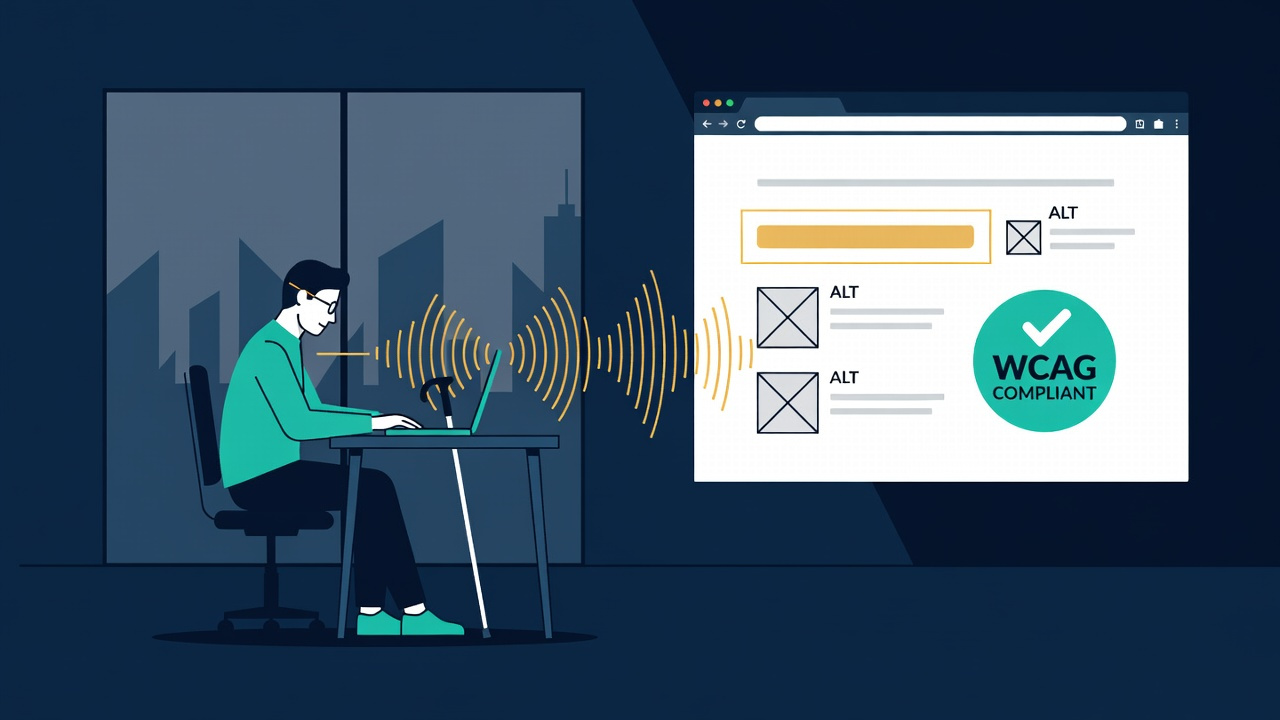
Digital barriers: In today's world, a company's website is often its digital storefront. An inaccessible website that cannot be used by people who rely on screen readers or other assistive technology can be a violation of the ADA, especially for New York-based retailers.
Restaurant and Retail Specific Barriers
New York's vibrant restaurant and retail scenes present unique accessibility challenges. Crowded city spaces often lead to violations that business owners overlook. Be aware of:
High counters: Transaction counters at coffee shops or checkout stands in stores that are too high for a wheelchair user to comfortably use.
Blocked aisles: Retail aisles cluttered with merchandise, displays, or boxes, making them too narrow for a wheelchair or walker to pass through.
Inaccessible outdoor dining: The rise of outdoor dining in New York City created many new barriers. A restaurant’s outdoor setup must be accessible, not crammed onto a sidewalk in a way that blocks passage or lacks accessible seating.
Service Animal Access Rights
Confusion about service animals is a frequent source of discrimination. The law is very clear. If you have a trained service animal, you have the right to be accompanied by that animal in all areas of a public accommodation where customers are normally allowed to go.
Where service animals are allowed: Everywhere the public is allowed. This includes dining areas of restaurants, hospital waiting rooms, and grocery store aisles.
The only two questions a business can ask: When it is not obvious what service an animal provides, staff may only ask two questions: (1) Is the dog a service animal required because of a disability? and (2) What work or task has the dog been trained to perform? They cannot ask about your disability, require medical documentation, or ask for a special ID card for the animal.
Emotional Support Animals (ESAs) vs. Service Animals: It is important to understand the distinction. In New York, under the ADA, only trained service animals (primarily dogs) have public access rights. Emotional support animals, which provide comfort but are not trained to perform a specific task, do not have the same legal protections for access to businesses.
New York State Human Rights Law vs. The Federal ADA
If you face discrimination in New York, you are protected by a "three-law stack": the federal Americans with Disabilities Act (ADA), the New York State Human Rights Law (NYSHRL), and, for city residents, the New York City Human Rights Law (NYCHRL). While the ADA sets a national baseline, New York’s laws often go much further, providing some of the strongest protections in the country.
This multi-layered protection is a significant advantage. For example, the NYSHRL applies to a broader range of businesses than the ADA, sometimes covering smaller companies that federal law might miss. The primary agencies for filing a claim in New York are the New York State Division of Human Rights (DHR) and, within the five boroughs, the NYC Commission on Human Rights (CCHR). These agencies are empowered to investigate claims and enforce state and city laws.
A core principle under all these laws is the requirement for "reasonable modifications." This means a business must make reasonable changes to its policies, practices, or procedures to afford access to individuals with disabilities, unless doing so would fundamentally alter the nature of the goods or services.
The Advantage of New York Protections
Filing a claim under New York law often provides a more direct path to resolution and justice. The benefits are clear:
Broader definitions of disability: New York law has a more expansive definition of "disability" than federal standards, meaning more people are covered and protected from discrimination.
Strict compliance timelines: State and city laws can impose strict deadlines on businesses to correct violations once a complaint has been filed and investigated.
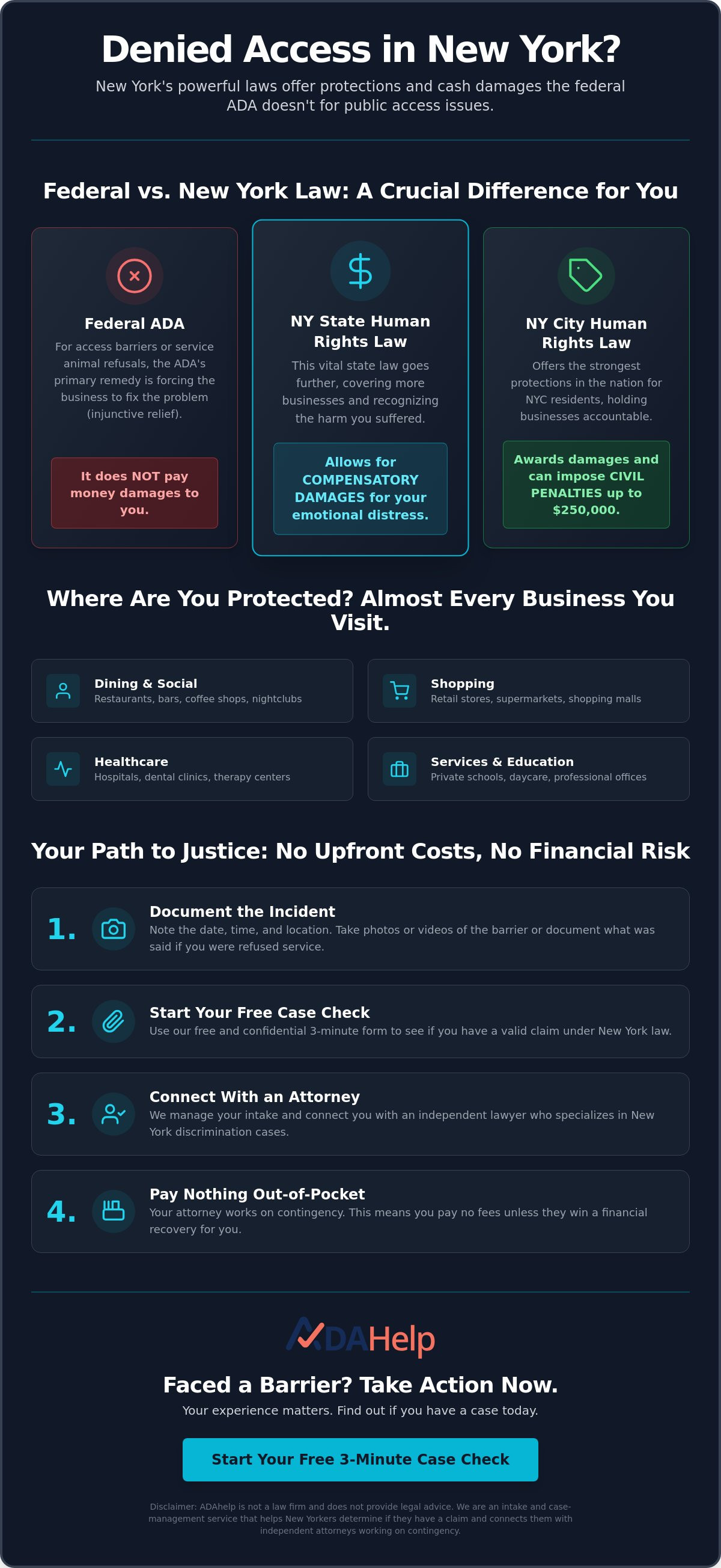
Potential for monetary damages: This is a critical difference. While the ADA's primary remedy for public access violations is injunctive relief (forcing the business to fix the problem), the NYSHRL and NYCHRL allow for monetary damages. This can include damages for emotional distress, and the NYCHRL even allows for punitive damages to punish egregious violators.
When Federal ADA Still Applies
Even with strong state and local laws, the federal ADA remains essential. Title III of the ADA sets clear architectural standards and requirements for all "places of public accommodation" across the country. It is the foundation upon which New York’s stronger protections are built. You can review the federal standards directly at ADA.gov.
Title III requirements: The ADA mandates the removal of architectural barriers in existing facilities when it is "readily achievable" to do so. For new construction and alterations, it sets strict accessibility standards.
Working together: Federal and state claims are not mutually exclusive. Often, a violation will break both federal and state law. An effective claim will cite all applicable statutes to build the strongest possible case for resolution.
The importance of documentation: Regardless of which law you ultimately file under, documenting the violation is the most important first step. The evidence you gather is what will drive your claim forward, whether it is with a federal, state, or city agency.
How to Document and Report a Violation
If you experience public access discrimination, the steps you take immediately afterward can determine the strength of your claim. The goal is to create a clear, factual record of what happened. You do not need to be a legal expert; you just need to be a good witness for yourself. Follow these steps.
Capture immediate evidence: Use your smartphone. Take photos or a short video of the physical barrier. If a manager or employee made a discriminatory statement, make a note of exactly what was said as soon as you can.
Identify witnesses: If anyone else saw what happened—a friend, family member, or even a sympathetic bystander—ask for their name and contact information. Their account can support your claim.
Document the details: Write down the date, time, and the business's name and address. If you interacted with staff, note their names or physical descriptions. The more specific you are, the better.
Keep a record of the impact: How did the incident make you feel? Humiliated? Frustrated? Angry? Also, note any practical impact. Did you have to go somewhere else? Were you late for an appointment? This information is relevant, especially for claims under state and city law.
Determine the best agency: In New York, you can generally file with the NYS Division of Human Rights. If the incident occurred in one of the five boroughs, you also have the option of filing with the NYC Commission on Human Rights.
What Makes a Strong Evidence File?
When you report a violation, you are not just telling a story; you are presenting evidence. A well-organized file makes your claim undeniable. Your goal is to show, not just tell, what happened.
Clear photos of the barrier: Take pictures from multiple angles. If possible, include an object for scale, like a wallet or keys, to show the height of a step or the narrowness of a doorway. A photo with a measuring tape is even better.
Screenshots of digital barriers: If you encounter an inaccessible website, take screenshots of the problematic pages or any error messages you receive. Note the date and the type of assistive technology you were using (e.g., a screen reader).
A written "incident diary": Create this immediately after the event while the details are fresh in your mind. Write a chronological account of what happened, who you spoke to, and what was said. Stick to the facts.
Common Mistakes to Avoid
Navigating this process can be tricky, and a few common missteps can weaken an otherwise valid claim. Be sure to avoid these:
Waiting too long to report: Strict time limits, known as statutes of limitations, apply. In New York, you generally have one year from the date of the discriminatory act to file a complaint with the Division of Human Rights. Waiting too long can mean losing your right to file.
Exaggerating the incident: Stick to the facts. Your credibility is your most important asset. A clear, honest account of what happened is far more powerful than an embellished one.
Failing to follow up: After you file a report, the process takes time. Failing to respond to requests for information from the investigating agency can cause your case to be dismissed.
How to File a Public Access Discrimination Complaint in New York
Once your evidence is organized, filing is a defined, step-by-step process. Here is how a public access discrimination New York complaint typically moves forward, the agencies involved, and the deadlines that matter most.
Choose your agency (or agencies): For incidents anywhere in the state, file with the New York State Division of Human Rights (DHR). For incidents in the five boroughs, you can instead file with the NYC Commission on Human Rights (CCHR). A purely federal Title III matter can also go to the U.S. Department of Justice, and disability-based employment issues go to the EEOC.
Mind the deadline: Under the NYSHRL you generally have one year to file an administrative complaint with the DHR (and up to three years to bring certain claims directly in court). NYCHRL complaints with the CCHR generally carry a one-year administrative deadline as well. Federal employment claims through the EEOC are typically 300 days.
Submit the complaint: File the agency’s intake form with your factual account, the business’s name and address, the date, and your evidence. You do not pay a fee to file, and you do not need a lawyer to start.
Investigation and response: The agency notifies the business, gathers evidence, and may interview witnesses. Both sides submit information, and the agency often attempts mediation toward an early resolution.
Determination and remedies: If the agency finds probable cause, the matter can proceed to a public hearing where it can order the barrier fixed and award damages. Many cases settle before that point.
Because one missed deadline or incomplete form can end a valid claim, many New Yorkers prefer to have a case manager handle the administrative filing and follow-ups rather than navigate it alone.
Remedies, Enforcement, and What Businesses Must Do
Understanding the remedies available — and what the law requires of businesses — helps you set realistic expectations for your claim.
Remedies and Enforcement
For public access violations, the federal ADA’s main remedy is injunctive relief: a court order requiring the business to remove the barrier, plus your attorney’s fees. New York’s enforcement goes further. The DHR and CCHR can order a business to fix the violation and award compensatory damages for your losses and emotional distress, and the NYCHRL allows punitive damages and civil penalties against repeat offenders. These enforcement actions are exactly why filing under state and city law usually produces a more meaningful result for the individual.
What Businesses Must Do to Comply
A place of public accommodation must remove architectural barriers where doing so is "readily achievable," provide auxiliary aids and services for effective communication, make reasonable modifications to discriminatory policies, and allow trained service animals. Businesses sometimes raise defenses — that a fix is not readily achievable, or would be an undue burden or fundamental alteration — but those defenses are narrow and frequently fail when a simple, low-cost fix was available. Knowing the standard helps you recognize when a business’s excuse does not hold up.
Navigating Your Claim with ADAhelp Case Management
You have rights, but enforcing them alone can be frustrating. Filing complaints, gathering evidence, and following up with government agencies is a time-consuming and often confusing process. Many valid claims are dismissed simply because people get overwhelmed by the bureaucracy and give up.
This is where ADAhelp provides a solution. We are not a law firm, and we do not provide legal advice. We are a professional case management service dedicated to helping New Yorkers resolve public access discrimination claims. We handle the entire process from start to finish, so you can focus on your life while we work to get you the resolution you deserve. When a claim needs legal representation, we connect you with independent attorneys who work on contingency and handle the legal work.
Our service operates on a contingency model. This means you never pay any upfront or out-of-pocket fees. We only get paid if your case is successfully resolved. Our 3-minute online check can quickly help you determine if you have a valid claim in New York. You can start your free case check whenever you are ready.
Professional Advocacy Without the Lawyer Fees
Our case management service is designed to give you expert support without the high cost of traditional legal representation. Here is how it differs:
Focus on process, not legal advice: While lawyers provide legal counsel, our case managers are experts in the administrative process. We know how to properly file claims with the DHR and CCHR, what evidence they need, and how to keep your case moving forward.
Expert evidence gathering: We work with you to build a strong, organized evidence file that clearly demonstrates the violation. Our experience with New York-specific ADA Title III issues means we know what investigators are looking for.
End-to-end support: We handle the paperwork, communicate with the agency on your behalf, and manage all the administrative deadlines and requirements. We take the burden off your shoulders.
Get Started Today
If you believe you have faced public access discrimination in New York, you do not have to accept it. Taking the first step is simple and risk-free.
Take the free 3-minute case check: Our secure online form helps you understand if you have a potential claim.
Expect a prompt evaluation: Once you submit your information, our team will evaluate your case to determine the best path forward.
Frequently Asked Questions
What is considered public access discrimination in New York? It is any instance where a business or public facility fails to provide equal access to people with disabilities. This includes physical barriers like stairs, discriminatory policies like "no service animals," or a failure to provide communication aids.
Can I file an ADA claim if a restaurant doesn’t have a wheelchair ramp? Yes. If a restaurant has a step or other barrier at its entrance and has not provided an accessible alternative like a ramp or lift, it is likely a violation of the ADA and New York Human Rights Law. This is one of the most common types of public access claims.
How much does it cost to file a disability discrimination claim in NY? There is no cost to file a complaint with the New York State Division of Human Rights (DHR) or the NYC Commission on Human Rights (CCHR). If you use a case management service like ADAhelp, we operate on a contingency basis, meaning there is no fee unless your case is successfully resolved.
Do I need a lawyer to report an inaccessible business in New York City? No, you are not required to have a lawyer to file a claim. However, the process can be complex. A case management service can organize your evidence and manage the administrative process for you, removing the stress and workload without the hourly cost of an attorney.
How long do I have to report a public access violation in NY? You generally have one year from the date of the discriminatory act to file a complaint with the NYS Division of Human Rights. It is critical to act quickly to ensure you do not miss this deadline.
What is the difference between ADA Title III and NY Human Rights Law? The federal ADA Title III sets the national standard for public access. The New York State and New York City Human Rights Laws are often broader, covering more businesses and, importantly, allowing victims to seek monetary damages for emotional distress, which is not typically available for these cases under the ADA.
Can I file a claim for an inaccessible website in New York? Yes. Courts have increasingly interpreted the ADA to apply to websites as "places of public accommodation," especially for businesses that have a physical location in New York. If a company's website is not accessible to people using assistive technology like screen readers, it can be the basis for a discrimination claim.
What happens after I report a business for a public access violation? After you file a complaint with an agency like the DHR, the agency will notify the business and begin an investigation. They may gather evidence, interview witnesses, and attempt to mediate a resolution. If a violation is found, the agency can order the business to fix the barrier and may award damages to you.

Article by
ADA Help
Written by the ADAhelp editorial team and reviewed for accuracy before publishing. ADAhelp helps New Yorkers find out if they have a disability discrimination claim and manages the process end to end, working with independent attorneys who handle the legal work. We are not a law firm and do not provide legal advice.
Disclaimer
This article is general information about New York law, not legal advice, and reading it does not create an attorney-client relationship. ADAhelp is a case-management and intake service, not a law firm; legal representation is provided by independent attorneys. Recovery amounts and timelines vary by case, and past outcomes do not guarantee future results. For advice about your specific situation, speak with a qualified attorney or start the free case check.
Tags
Discriminated against in New York because of a disability?
A free three-minute check tells you if you can pursue a claim.
Check my case →New York onlyNo upfront costIndependent NY attorneysFree 3-minute check